
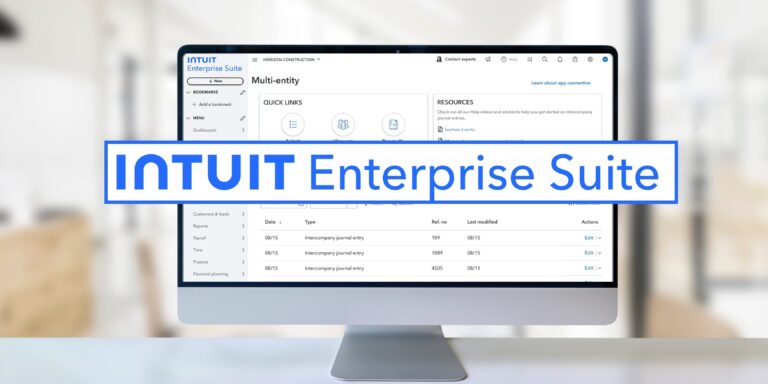
Intuit Enterprise Suite: Mid-Market Accounting Revolution
For decades, QuickBooks has been synonymous with small-business accounting. But as companies grow, they inevitably face a dilemma: their financial needs become too complex for lightweight tools, yet full ERP systems feel like overkill. They’re too costly, too rigid, and too slow to implement.
Enter Intuit Enterprise Suite (IES)! A brand-new cloud platform designed to bridge that gap. Officially launched in late 2024, IES represents Intuit’s bold move into the enterprise-grade, multi-entity accounting space. For growing businesses and accounting professionals alike, it’s a sign that Intuit is thinking beyond bookkeeping. It’s building a true operating system for modern finance teams.
The Mid-Market Gap Intuit Wants to Fill
Until now, mid-sized organizations (say, $3M–$100M in revenue) have been forced to choose between two unsatisfying extremes: Stay on smaller tools like QuickBooks Online or Desktop Enterprise, then manage complex reporting in spreadsheets. Or leap to a full ERP like NetSuite, Sage Intacct, or Microsoft Dynamics. All powerful but expensive and time-consuming to deploy.
Intuit’s data shows this “missing middle” is enormous. Thousands of firms have outgrown QuickBooks but aren’t ready for ERP complexity. IES aims to offer ERP-level capability with the simplicity and accessibility of QuickBooks.
What exactly is Intuit Enterprise Suite?
At its core, IES is a cloud-based financial management platform with deep accounting, automation, and multi-entity functionality built in. But Intuit didn’t stop there. The platform also includes:
- Multi-entity management for complex organizational structures.
- Multi-dimensional accounting, letting teams track performance across dimensions like region, department, and project, all within one ledger.
- AI-driven automation, including “agents” that assist with reconciliations, cash-flow forecasting, and project tracking.
- Industry-specific workflows, with the first rollout tailored to construction and project-based businesses.
IES is built natively in the cloud and integrated with Intuit’s broader ecosystem, meaning it can connect seamlessly with QuickBooks Online, TurboTax, and even third-party apps via open APIs.
Multi-Entity, Multi-Dimensional: The Big Leap
Perhaps the most revolutionary part of IES is its multi-entity architecture. Instead of juggling multiple company files, users can consolidate financials, eliminate inter-company transactions, and report across subsidiaries instantly.
On top of that, IES introduces custom “dimensions.” Rather than tracking performance by just classes or locations, users can define dimensions for customers, projects, cost centers, or funding sources. That opens the door to reporting that looks and feels like ERP-level analytics without the ERP headache.
Imagine being able to ask: “What’s the gross margin by project type across all entities in Q3?” and getting that answer in seconds, without pivot tables. That’s the kind of visibility IES promises.
AI and Automation: Intuit’s Secret Weapon
Intuit has been building artificial intelligence into its products for years, and IES takes that to a new level. The platform introduces AI Agents: smart assistants that learn from your data and handle routine financial processes. They can:
- Reconcile transactions and flag anomalies.
- Suggest budget re-forecasts based on spend patterns.
- Automate invoicing and payment scheduling.
- Generate quick financial summaries for leadership.
In other words, IES doesn’t just manage data, it interprets it, saving teams hours of manual work each month.
Why Construction Came First
The first industry Intuit targeted with IES is construction, one of the most accounting-intensive and fragmented sectors.
In construction, project costing is everything: budgets, change orders, job tracking, labor, materials, progress billing. And all of it across multiple projects and entities. Existing systems often require juggling multiple tools or relying on spreadsheets. IES brings those workflows into one place.
Features like real-time project profitability tracking and change order management are built directly into the financial core, not bolted on later. That’s a big deal for CFOs and controllers who live in Excel hell every month.
Built for Collaboration and Scale
Unlike legacy desktop systems, IES lives fully in the cloud, meaning it’s built for teams. Permissions, role-based access, and audit trails make collaboration easier while maintaining control.
As organizations scale, new entities can be added instantly without spinning up a new “file.” Shared charts of accounts, inter-company automation, and consolidated dashboards make growth far smoother.
Who Should Look at IES
IES isn’t designed for freelancers or startups. It’s set up for:
- Companies with multiple legal entities or divisions.
- Firms that need multi-dimensional reporting beyond classes or departments.
- Industries like construction, real estate, or professional services where project costing and reporting drive profitability.
- Accounting firms managing multiple client entities.
If your organization is bumping against the limits of QuickBooks Online or Enterprise Desktop, especially in multi-entity or consolidated reporting, IES is absolutely worth exploring.
The Strategic Move Behind IES
IES isn’t just another Intuit product. The company is moving decisively into the mid-market ERP space, where competitors like NetSuite, Sage, and Acumatica have long dominated.
But Intuit’s differentiator is clear: make enterprise-grade accounting intuitive. Keep the simplicity, transparency, and approachability that made QuickBooks a household name, but scale it to the next level.
The Bottom Line
Intuit Enterprise Suite represents a major evolution in Intuit’s ecosystem. It’s more than upgraded bookkeeping software, it’s a full-scale financial platform designed for modern, multi-entity businesses.
For CFOs tired of endless spreadsheets and disjointed systems, IES offers something new: true enterprise capability, built with QuickBooks simplicity.
Next week we’ll explore how companies are actually implementing IES. What migration looks like, lessons from early adopters, and how to decide if it’s the right time for your business to make the leap.
Related Posts on Redmond Accounting CA